
An evidence-informed look at a nonsurgical, needle-free approach to hair restoration
Have you ever looked at an older photo and thought, “My hair used to look so much thicker”?
Perhaps your ponytail feels smaller, your part appears wider, or you are noticing more hair than usual in the shower. Hair thinning is common among both women and men, particularly with age, but that does not make it any less frustrating.
Advances in laser technology have introduced new nonsurgical approaches to hair restoration. One treatment receiving attention is Fotona HairRestart, a noninvasive laser protocol supported by a growing—but still developing—body of clinical research.
How does it work, what does the research actually show, and who might be a candidate?
Important: Hair loss has many possible causes. A professional evaluation is important before beginning treatment, particularly when hair loss is sudden, patchy, rapidly progressing, associated with scalp symptoms, or accompanied by other health changes.
Why Does Hair Begin to Thin?
Hair grows in cycles. Each follicle moves through an active growth phase, a transitional phase, and a resting phase before the hair is eventually shed.
A variety of factors can disrupt this cycle, including:
- Genetics
- Hormonal changes
- Stress or illness
- Nutritional deficiencies
- Certain medications
- Thyroid conditions
- Autoimmune or inflammatory conditions
- Changes associated with aging
One of the most common causes of progressive thinning is androgenetic alopecia, also known as male or female pattern hair loss.
With androgenetic alopecia, affected follicles may gradually produce finer and shorter strands. Over time, the hair can appear less dense and the scalp may become more visible.
Identifying these changes early may provide more opportunities to preserve existing hair and develop an appropriate treatment plan.
What Is Fotona HairRestart?
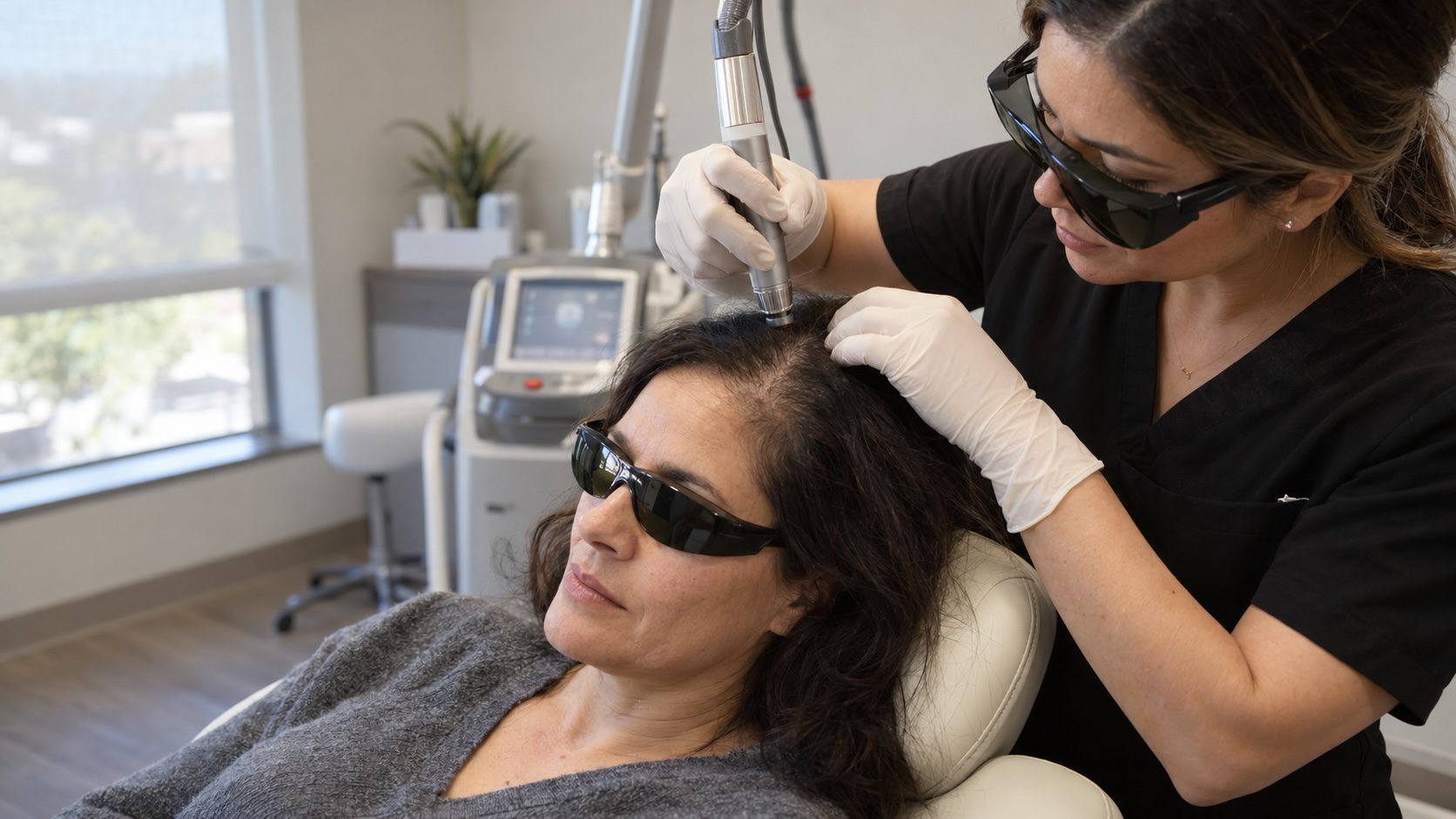
Fotona HairRestart is a noninvasive treatment that uses a 2,940 nm Er laser in a specialized non-ablative SMOOTH mode.
Unlike an ablative resurfacing procedure, the treatment is designed to deliver controlled thermal energy without intentionally removing the scalp’s surface. The goal is to influence the tissue surrounding the hair follicles and potentially support biological processes associated with hair growth.
Researchers continue to investigate the precise mechanisms involved. Proposed effects include changes in follicular activity, circulation, cellular signaling, and the surrounding scalp environment.
HairRestart should not be understood as creating new follicles. Instead, it is intended to support existing follicles that may still be capable of producing hair.
What Does the Research Show?
Current research is encouraging, but it is important to place the findings in context. The available studies are relatively small, and some participants have received additional hair-restoration therapies.
A 2022 Study of 16 Patients
A study published in the Journal of Cosmetic Dermatology evaluated 16 women and men with androgenetic alopecia who received non-ablative Er laser treatments.
In blinded evaluations of clinical photographs, researchers rated hair quality as improved in 93% of participants. The participants also reported high satisfaction and a median discomfort score of 2 out of 10. No adverse reactions were reported in this small study.
However, some participants also used platelet-rich plasma, topical minoxidil, or oral supplements. The results therefore cannot be attributed to the laser treatment alone. The study was also small and did not include a sham-treatment control group.
Review the 2022 study
A 2025 Clinical Observation
A separate 2025 clinical observation followed 32 patients with androgenetic alopecia who received six non-ablative Er SMOOTH-mode treatments at two-week intervals.
The authors reported visible clinical improvement and high patient satisfaction. Mild scalp scaling was the only adverse effect reported. However, this was also a small observational study without a sham-treatment comparison, so its findings should be considered preliminary.
Review the 2025 clinical observation
A 2025 Systematic Review
A 2025 systematic review examined 12 studies involving a total of 344 patients treated with Er or Er lasers for androgenetic alopecia.
Across the included studies, researchers reported encouraging findings related to hair density, growth rate, and thickness, with generally favorable safety outcomes. However, treatment methods and patient responses varied considerably.
The review included different erbium laser technologies and was not limited exclusively to the Fotona HairRestart protocol. Larger randomized and controlled studies are still needed to determine long-term effectiveness, ideal treatment protocols, and which patients are most likely to benefit.
Review the 2025 systematic review
What Is a HairRestart Treatment Like?
During treatment, laser energy is delivered systematically across the scalp.
Patients may experience warmth or mild discomfort, but treatment is generally described as well tolerated in the published studies. There are no surgical incisions or injections involved in HairRestart itself.
Temporary effects may include:
- Warmth or tenderness
- Mild redness
- Dryness or scaling
- Temporary scalp sensitivity
More significant complications may be possible, although uncommon when treatment is appropriately selected and performed. Individual risks can vary based on skin type, medical history, medications, treatment settings, and other factors.
HairRestart is typically performed as a series of treatments. The recommended number and timing of sessions should be individualized by a qualified provider.
When Might Results Become Visible?
Hair grows slowly, so changes should not be expected immediately.
Patients who respond may begin to notice gradual changes over several months. Progress may involve reduced shedding, improvement in the appearance of hair quality, or increased visible density.
Not every patient will respond, and the degree and duration of improvement can vary. Maintenance treatments or ongoing home care may be recommended.
HairRestart cannot be expected to restore follicles that are permanently inactive or absent, and it is not a guaranteed solution for every type or stage of hair loss.
Can HairRestart Be Combined With Other Treatments?
Hair restoration is not always about selecting one treatment.
Depending on the cause and pattern of hair loss, an individualized plan may include:
- Fotona HairRestart
- Platelet-rich fibrin, or PRF
- Appropriately selected topical or oral treatments
- At-home light-based devices
- Nutritional or medical evaluation
- Scalp and hair-care recommendations
PRF is prepared from a patient’s own blood and contains platelets and naturally occurring signaling proteins. Its potential role in hair restoration continues to be studied.
Although combination treatment may be appropriate for some patients, research has not established that combining Fotona HairRestart specifically with PRF will consistently produce better results than either approach alone.
Each option has its own benefits, limitations, contraindications, and potential risks. Treatment recommendations should be based on an individual evaluation rather than a standardized package.
Is Fotona HairRestart Right for You?
HairRestart may be worth discussing if you are experiencing gradual thinning or early-stage pattern hair loss and prefer a nonsurgical treatment without injections.
A proper evaluation is essential. Hair shedding may be connected to iron deficiency, hormonal changes, thyroid conditions, medications, illness, inflammation, autoimmune disease, or other medical factors that require a different approach.
Laser treatment may not be appropriate for every person, every skin or scalp condition, or every type of hair loss.
A Personalized Approach to Hair Restoration
Hair thinning can affect more than appearance. It may influence how you style your hair, how you feel in photographs, and your everyday confidence.
At Infinite Wellness Med Spa, we believe in combining innovative technology with realistic expectations, careful evaluation, and individualized care.
Fotona HairRestart represents a promising noninvasive option for certain forms of hair thinning. The early research is encouraging, but it should be understood as emerging evidence—not a guarantee of regrowth.
Because healthy-looking hair is not about chasing perfection. It is about finding an informed plan that supports your goals and helps you feel more confident in your own hair.
Interested in Learning More?
Schedule a personalized hair-restoration consultation at Infinite Wellness Med Spa in Pasadena, California, to discuss your concerns, possible contributing factors, and whether Fotona HairRestart may be appropriate for you.
Medical and Results Disclaimer
This article is provided for general educational and informational purposes only. It is not medical advice and should not be used to diagnose or treat hair loss or any other medical condition.
Fotona HairRestart is a branded treatment protocol. Device clearances, approved indications, availability, and permitted uses may vary. A qualified provider can explain the regulatory status and proposed use of the treatment during your consultation.
Individual results vary, and no specific result, amount of hair growth, or duration of improvement is promised or guaranteed. Published studies may involve small sample sizes, different treatment protocols, combination therapies, and patient populations that may not reflect an individual patient’s experience.
Laser treatment may cause temporary redness, warmth, tenderness, dryness, scaling, swelling, pigment changes, or other adverse effects. Less common or serious complications are also possible. PRF and other procedures have separate risks and require separate informed consent.
Treatment suitability must be determined through an individualized consultation that considers hair-loss pattern, scalp condition, skin type, medical history, medications, and treatment goals. Patients experiencing sudden, patchy, severe, or unexplained hair loss should seek evaluation from an appropriately licensed medical professional.
Mention of a study, product, device, or treatment does not constitute a guarantee, endorsement, or representation that it is appropriate for every patient.
References
- Day D, McCarthy M, Talaber I. “Non-ablative Er laser is an effective tool in the treatment arsenal of androgenetic alopecia.” Journal of Cosmetic Dermatology. 2022;21(5):2056–2063. PubMed
- Zhang Q, et al. “Nonablative Er Laser Treatment of Androgenetic Alopecia: A Clinical Observation.” Dermatologic Therapy. 2025. Full article
- Nilforoushzadeh MA, et al. “A systematic review of erbium lasers in the treatment of androgenetic alopecia.” Lasers in Medical Science. 2025;40(1):239. PubMed